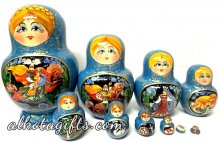
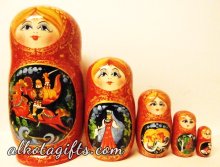
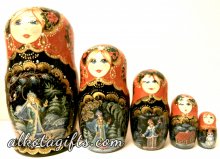
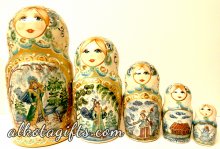
"As the bells began to announce the Zautrenya (early mass) hence I saw from my light room (svetlitsa),
as the good people happily hurry to church, so girlfriends, it became
unbearable... Since then my heart is heavy still... and the day was so bright,
so filled with sunshine, and these garments that you put onto me... Take off
these bracelets, girlfriends, take off the kokoshnik,
make my hair into a braid, like you have maiden-like!"
"Are you out of your mind, Boyarinya, such a
sin! You want the braid made maiden-like! God have Mercy! What if Drujina Andreich finds out about
this!"
"He will not find out, girlfriends! I will put the kokoshnik back on!"
--(A.K. Tolstoy "Prince Silver" chapter 5,
1862)
A kokoshnik (pronounced kah-KOSH-nick)
is the headdress worn by a married woman in the central and northern regions of
Russia
.
The headdress was worn in other regions as well, but it did not have any status
symbolism to it. It is shaped as a high shield, of various designs above the
forehead.
The name kokoshnik come from the Ancient Russian
"kokosh" for a broon-hen,
as opposed to a "kokot" for hencock, and is based on the form of the bird's crest. The
shape of the kokoshnik varies from region to region.
Ethnographers have written the following: "The shapes of kokoshniks from the Northern Regions vary greatly even from
regions quite close to each other. In the Ostashkovo region the surface of the helmet-like head covering was filled with "pozument" and thick gold thread embroidery, and the
area next to the forehead ended in a grid of pearls or beads. Whereas as a
headdress from the nearby Rjevskiy region "ryaska" was miniature in comparison; its richly
decorative band covered just a bundle of hair on the back of the head, and a
thick grid "pozatilen" covered the rest of
the head. A kokoshnik from the Kargopolkiy Uyezd of the Olonetsk region resembles a hat with a band
stretched outward with fans covering the ears. The surface of this kokoshnik is decorated with "pozument"
and the forehead part is decorated with geometrical designs, laid out with
pearls and beads. A short multilayer decorative grid is lowered over the
forehead. A "kika" from the Pskovian region had unusual decorations in the form of
cones, embroidered over white with pearls and beads, which resembled fertility,
according to ancient belief.
In Vladimirskaya, Nizhegorodskaya, Yaroslavskaya, Kostromskaya and several other regions in the 18th century flat massive kokoshniks with a vertical or horizontal fan above the forehead are typical. These can be
of a stretched upright triangle or rounded shape. In some cases they can be as
long as
60 cm
(
24 in
).
Kokoshniks were made by highly skilled craftsmen, who
knew how to embroider with pearls, gold thread and were trained in the handling
of factory made materials. In the artistic order of the Russian national
costume, a kokoshnik was the crowning monumental
shape of formal women's attire. It accented the face, underlining the
importance of the festive situations when such a richly decorated headdress was
appropriate. For a short time after being married, women would attach a
transparent white veil, decorated with lace or pozument.
This veil is called several different names: the dymka (smoke layer) or the fata or vyual (both meaning veil). In time, a very high kokoshnik with a veil began to be worn by young unwed
women. In
1900, M
.A. Vrubel painted the very famous painting
"Princess Swan" (Tretyakov Gallery), where
the kokoshnik was a key detail, organically woven
into the composition, represented as a national symbol of traditional Russian
costume, with a metaphoric fairytale-like poetry to it. In present time the kokoshnik resembles the beauty of a young maiden and has
lost the connection to married status. Nowadays it is mostly used in theatrical
scenes.
|