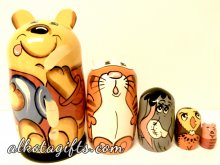
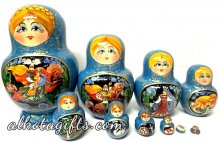
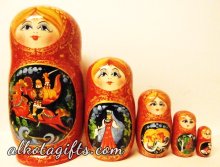
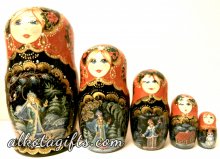
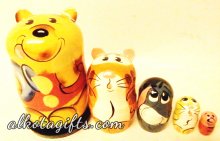
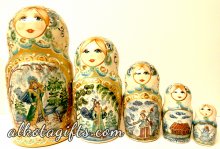
Nesting dolls with scenes from Russian fairytales are one of the most popular and collectible Russian matryoshkas. Many fairytales were based on old Russian folkloric tales which had been gathered by the people and called bilini - oral forms - for centuries. Those stories had origins in religious pagan beliefs in magic idols, "powers", fictional characters. Many of them were implemented and broadly used in narrations which became fairytales. Such characters as Russian witch Baba Jaga, "Solovei Razboinik", Russian knights "bogatiri" Alesha Popovich, Ilia Muromets just reflect Russian people's understanding and distinguishing of good and bad, wishing the evil always to go down. A major role in Russian fairytales is played by animals, also kind or cruel. You can see that the bear is frequently painted on nesting dolls. Russians love him, because he is kind and fair, and is on the side of the main "positive" hero. The fox and wolf are tricky and not fair, and try to take advantage of the situation . So their portraits and behavior are funny and expressed in caricature.